
Stefan Knirck
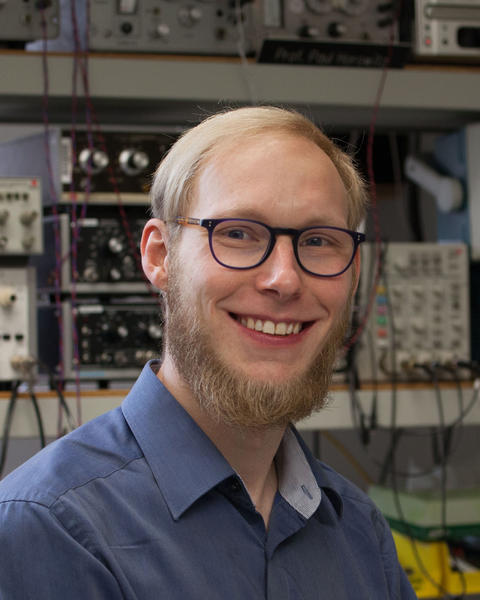
Faculty Assistant: Seth Lewis
Stefan Knirck is an experimentalist searching for axion dark matter using novel detectors. Axion dark matter searches are at the intersection between fundamental particle physics, astrophysics, photonics, and quantum sensing.
An axion is a hypothetical fundamental particle that would explain why we do not observe a neutron electric dipole moment. It was first independently postulated by Frank Wilczek and Steven Weinberg based on a theory proposed by Roberto Peccei and Helen Quinn. It is also theorized to be a component of dark matter naturally produced in the early Universe. If axion dark matter exists, it can be converted to photons in a strong magnetic field in a lab on Earth with the help of an electromagnetic resonator. Knirck’s group will focus on the development of novel high-quality-factor resonators and large-volume setups for axion-photon conversion. These setups will be employed in a cryogenic environment and high magnetic fields connected to the most sensitive photon detectors in existence.
Knirck is part of the ADMX, MADMAX and BREAD collaborations. ADMX (Axion Dark Matter eXperiment) is one of the world-leading axion experiments, searching for axions at around few µeV masses. ADMX uses m-scale resonant cavities at GHz frequencies with the diameter set by about half a photon wavelength. MADMAX (MAgnetized Disk and Mirror Axion eXperiment) aims to detect axions with about one to two order of magnitude larger mass. MADMAX employs multiple dielectric layers to enable coherent axion-photon conversion in a volume much larger than a wavelength cubed. BREAD (Broadband Reflector Experiment for Axion Detection) fully decouples the size of the experiment from the wavelength, and hence axion mass, by converting axion dark matter non-resonantly: On a magnetized metallic surface axions can convert to photons emitted perpendicular to the surface. BREAD uses a novel reflector geometry to make this concept compatible with high-field solenoid magnets. This concept makes the meV mass range (mm-wave photons) and above accessible to axion dark matter searches.
Axion searches, while traditionally rooted in particle physics, have synergies with a range of other fields of physics. Large resonant cavities and magnetic fields are at the heart of particle accelerators. At higher frequencies axion searches borrow technology from radio and mm-wave astronomy and photonics, such as telescopes built to measure the cosmic microwave background radiation. Quantum information community’s advances in single photon detection are directly applicable to axion searches, promising to significantly improve sensitivity beyond the standard quantum limit. Axion dark matter searches employ the world’s most sensitive detectors for electromagnetic signals, and these setups can also be used to search for other, related, dark matter candidates and high-frequency gravitational waves.
Knirck studied physics in Heidelberg and built what is likely the world’s first dark photon dark matter direct detection experiment in the meV range at The University of Tokyo and University of Fukui in 2016. He obtained his Ph.D. summa cum laude at the Max-Planck-Institute of Physics and the Technical University of Munich in 2020 for studies on MADMAX, his thesis being recognized as “Best Ph.D. thesis of 2020” within his Collaborative Research Center, SFB1258. After graduation, Knirck worked as a research associate at Fermilab making essential contributions to ADMX. Moreover, he led the design, build and run of the first BREAD prototype. His work leveraging synergies between all three collaborations was recently honored with the DESY International Fellowship Award. Knirck will join Harvard as an assistant professor in January 2025.