
IceCube Group
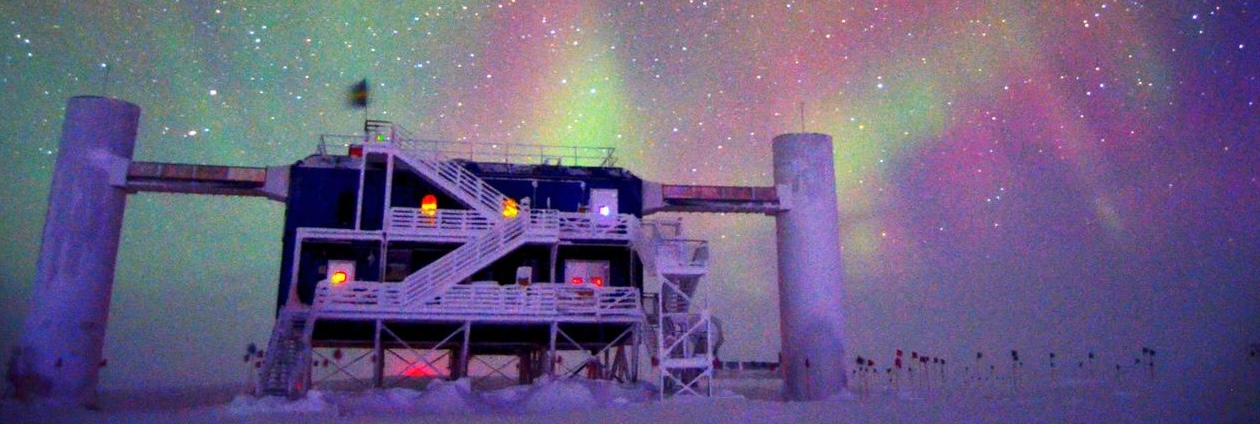
The IceCube group at Harvard University is led by Prof. Carlos Argüelles-Delgado. Our main objective is to uncover new neutrino properties using high-energy atmospheric and astrophysical neutrinos. The neutrinos that we study have some of the highest energies ever observed and have traveled the longest distances from production to detection. This allows us to perform extreme tests of fundamental physics by using astrophysical neutrinos, which are very long interferometers. The main questions that our group tackles are the following:
- What is the nature of neutrino masses?
- What can we learn from the study of high-energy astrophysical neutrinos?
- How do we use new technologies, such as machine learning or quantum computers, to increase the reach of our detectors?
- How do we take neutrino telescopes to the next level? How should we build new ones?
To answer these questions, our group is engaged in every aspect of the experiment work and design, from hardware to high-level physics analyses. More specifically, our physics data analyses work using more than ten years of data from the IceCube Neutrino Observatory, the largest neutrino telescope currently operating. We also work on machine learning applications for neutrino telescopes and the development of new Monte Carlo methods to improve the description of these detectors. We have a strong tradition of working closely with theorists to develop new ideas that end up as IceCube analyses. Finally, we are engaged in developing new devices for the upcoming IceCube Upgrade and developing new high-energy neutrino experiments such as TAMBO.
Project Areas
Particle Physics
We use high-energy neutrinos from the atmosphere and from astrophysical sources to test Standard Model predictions, make measurements, and search for new Beyond Standard Model (BSM) phenomena. We search for new particles, new forces, and new space-time symmetries.

Neutrino Astronomy
We develop new methods to search for neutrino sources and study their properties. We also use these cosmic baselengths to make conclusions about particle physics.

Machine Learning and Reconstruction
We use machine-learning techniques to improve neutrino telescope performance and reconstruction.

Hardware
We do a variety of hardware construction and testing for IceCube and broad outreach initiatives.

Simulations and Software Development
We develop simulations and analysis software for IceCube and other neutrino telescopes. We are especially interested in open source neutrino event generator development.

Theory and Phenomenology
Our group does work in fundamental theory and how these theories translate to experimental signals.

Companion Experiments
We are also involved in the development and analysis of other experiments that complement IceCube.
- TAMBO
- KM3NeT

Outreach
We are involved in a variety of outreach projects aimed at secondary school students and the general public.

Faculty
Carlos Argüelles Delgado

Postdoctoral Fellows
Gonzalo Herrera

Nicholas Kamp

Will Thompson

Graduate Students
Julia Book Motzkin

Kiara Carloni

Miaochen (Andy) Jin

Tanvi Krishnan

Alex Wen

Felix Yu

Pavel Zhelnin

Undergraduate Students
Luc Bojorquez-Lopez

Miller MacDonald

Linda Wnetrzewska


